
GUIDE
Wall-mount your curtain track
Mounting curtain tracks on the wall sometimes requires a little more planning than ceiling mounting. The biggest difference is the distance between the curtain track and the wall, where different wall brackets may be needed to adjust the distance. A wall-mounted curtain track is also a good option if you don't want to or can't drill into the ceiling, or if sloped ceilings, stucco, or aesthetic preferences mean you want to place the curtains lower towards the window.
Most of Hasta's curtain tracks can be wall-mounted, but there are a few things to consider when choosing a wall-mounted track. In this guide, you will get practical tips and advice on which models are best suited when you want to install a curtain track with wall brackets – whether you are planning for single or double curtains.
Which track should I choose?
Most curtain tracks work well for wall mounting. Just like with ceiling mounting, you choose the track based on both style and function – what look you want, what pleats you use, and how heavy your curtains are.

Convex

Alex

U-rail
For slightly heavier curtains, models like Convex and Alex are stable options well-suited for wall mounting, especially if you want the curtain to cover the track using glide hooks. Other models, such as the popular U-track, can also be easily wall-mounted. It is neat and discreet and is particularly suitable when you want to hang curtains with hotel waves.
Many of our curtain tracks are available as complete packages with wall brackets, where the length of the wall bracket varies depending on the model. If you need a greater distance from the wall – for example, with deep window sills or other obstacles – you can add angles in different lengths to achieve the correct distance.
| Runaway | Suitable for | Assembly | Hooks |
|---|---|---|---|
| U-track | Lightweight curtains | Roof + wall | Gathering tape and eyelet hook |
| Alex | Medium-weight curtains | Roof + wall | All curtain hooks |
| Convex | Medium-weight curtains | Roof + wall | All curtain hooks |
| Cabin rail | Heavy curtains | Roof + wall | All curtain hooks |
| Motorized tracks | Heavy curtains | Roof + wall | See respective rail |
| Hotel curtain track | Medium-weight curtains | Roof + wall | Wave/rufflette hook and deep pleat long neck hook |
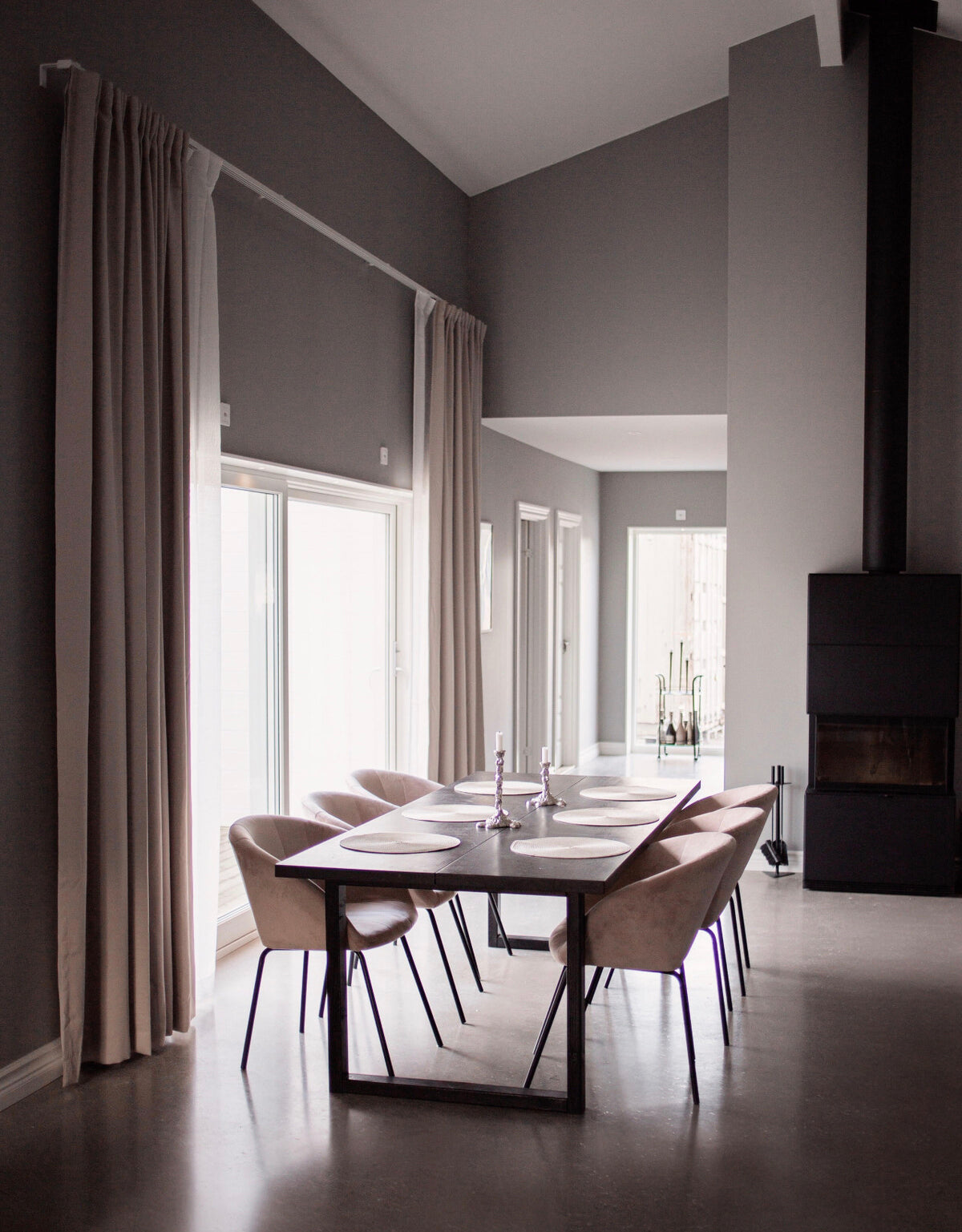
Double curtains with wall mounting
Do you want double curtains for a hotel feel but need to wall-mount your tracks? Then you use two separate curtain tracks mounted in double layers. For both curtain layers to hang freely, you need to choose longer wall brackets or supplement with angles that provide sufficient distance from the wall.
The length you need for wall brackets or angles depends both on the pleats you use and whether there are obstacles such as windowsills, radiators, or pipes. Curtains hung in hotel waves build up more backward compared to curtains with finger hooks, which means they often require longer brackets and more space between the tracks.
Curtains with finger hooks, however, take up very little space, and in that case, it is primarily the room's design and any obstacles that affect how far out the tracks need to be.
Mount a curtain rail on the wall – step by step
Wall-mounting curtain tracks differs from ceiling-mounting primarily in that you work with wall brackets or angles, which must be placed at the correct height and at the correct distance from the wall. Here is a general overview of how wall mounting is done, regardless of which track model you are using.
- Mark height and placement
Measure the height and mark a straight line where the wall brackets or angles should be placed. Use a spirit level or laser to ensure a straight result – small deviations are clearly visible once the track is installed. - Mark the mounting points
Place the wall brackets or angles against the wall and mark where the screws should be placed. A general recommendation is approximately 50 cm between each mounting point. For heavy curtains, you may need a shorter distance. If the track is spliced, you should always place an extra bracket directly at the splice to prevent sagging. - Drill and install the wall brackets
Drill the holes and attach the wall brackets with screws and plugs that are suitable for your wall material. Check that all brackets are at the same height – this is especially important if the wall is uneven or constructed of multiple materials. - Prepare angles if necessary
If you are using angles, screw the part that will hold the track directly onto the angle. If you are using standard wall brackets, you can skip this step. - Attach the track to the brackets
Once the wall brackets or angles are securely in place, install the track itself.
Depending on the model, the track is either clicked into the bracket or screwed into place.
Check that the track is firmly attached without any play and that it is stable in all brackets.
Here you will find our instructional videos for the most common models.