
GUIDE
How to hang curtains
There are several different ways to hang curtains, and the choice of curtain suspension depends on the type of arrangement and function you want. Hasta's curtains come with a combi-tape (also called multi-tape), which makes it possible to hang curtains in several different ways. You can hang the curtains on a curtain track (in the glider of the track) or on a rod (with curtain rings), and use different types of curtain hooks depending on the desired arrangement and function. You can also hang the curtain directly on a curtain rod using the loops in the combi-tape, and then you won't need any curtain hooks at all.
In this guide, we will go through the function of the combi-tape and some of the most common curtain arrangements step by step. This way, you will get a clear overview of how curtains can be hung and what distinguishes the different suspension methods.
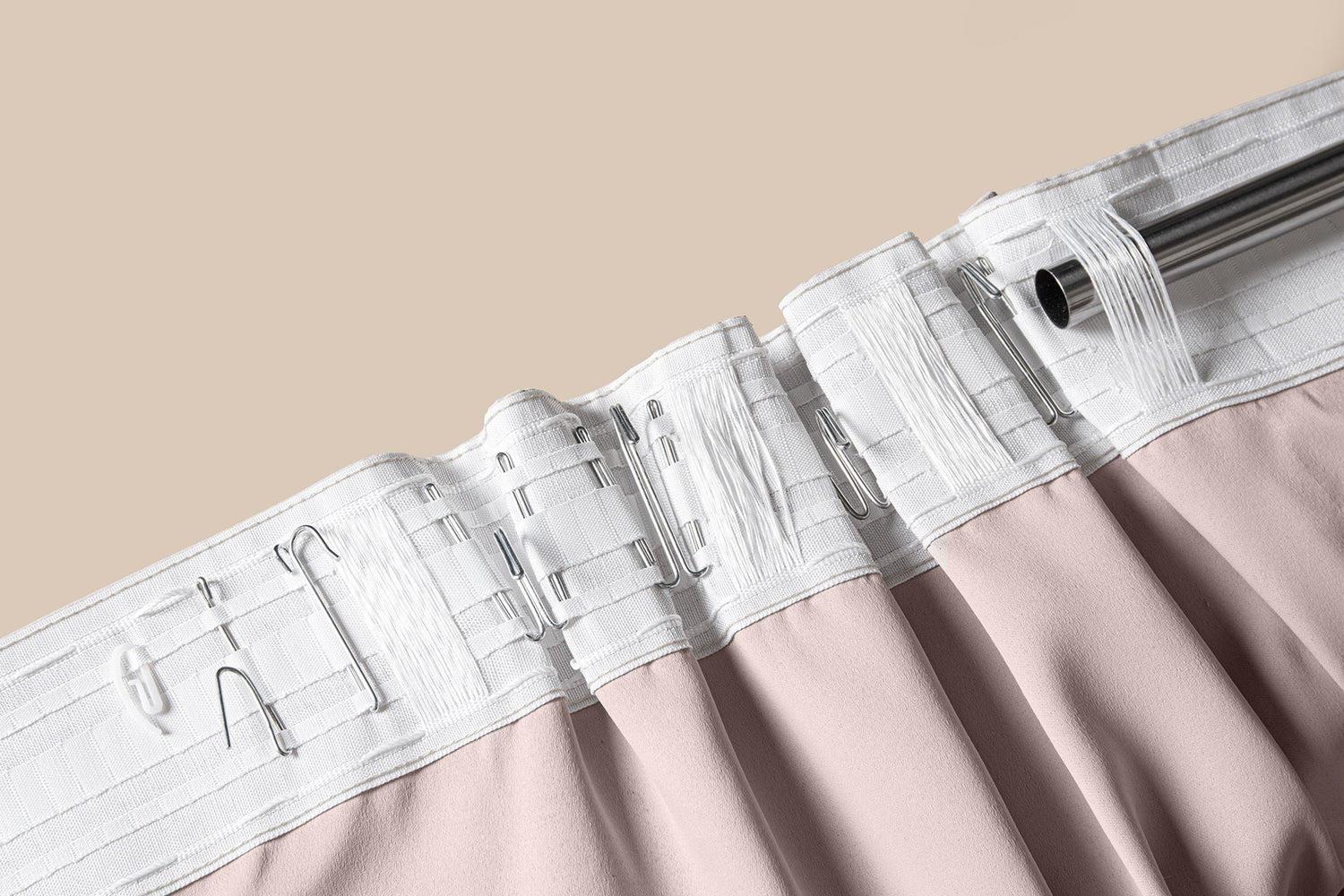
Gathering tape hook | 1-prong hook with low fit | 1-prong hook with high fit | 2-prong hook with low fit | 2-prong hook with high fit | 4-prong hook with low fit | 4-prong hook with high fit | Curtain rod through loop


Pleated heading hooks for hotel waves
With pleating hooks, you can create hotel waves, also known as wave curtains. Pleating hooks can be used with a curtain track, where the hooks are hung in the track's gliders, and also with curtain rings on a rod for the same type of setup. The pleating hooks are inserted into the small loops at the very top of the combi tape.
The distance between the hooks affects how large the waves will be. Use an even number of hooks to achieve a neat finish on both sides of the curtain.
- Standard: Place the hooks approximately 10 cm apart.
- Gliders on cord: Approximately 16 cm between each hook often gives the best results.
For a more in-depth explanation of this type of hanging, you can watch our instructional video on hotel waves.

1. Insert the pleat hook into a pocket at the top of the combo tape.

2. Turn the hook so that it locks into the hem. Repeat along the entire curtain at even intervals between the hooks.

3. Shape the waves: push every other wave forward and every other wave backward along the curtain.

4. Check the result: the curtain should have even, regular waves along its entire width.
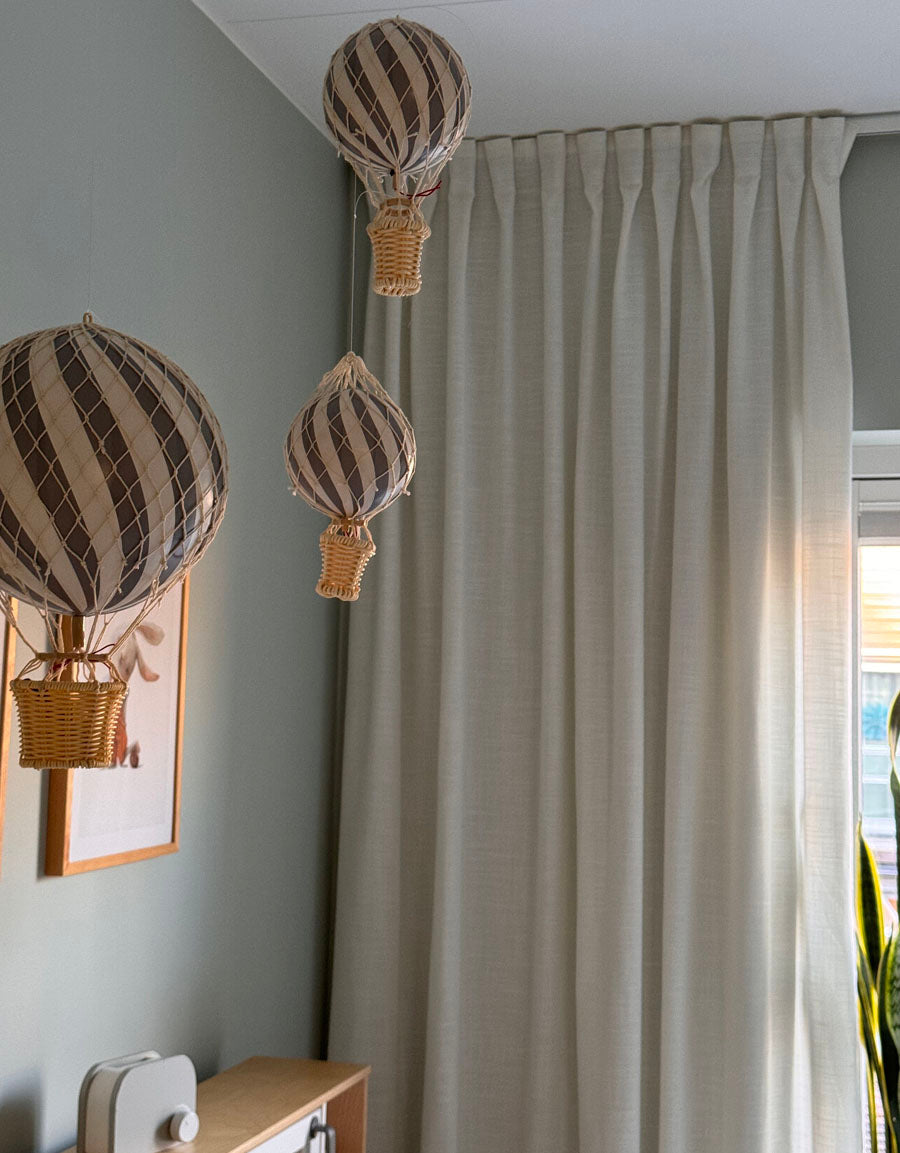

Finger hooks for elegant pleats
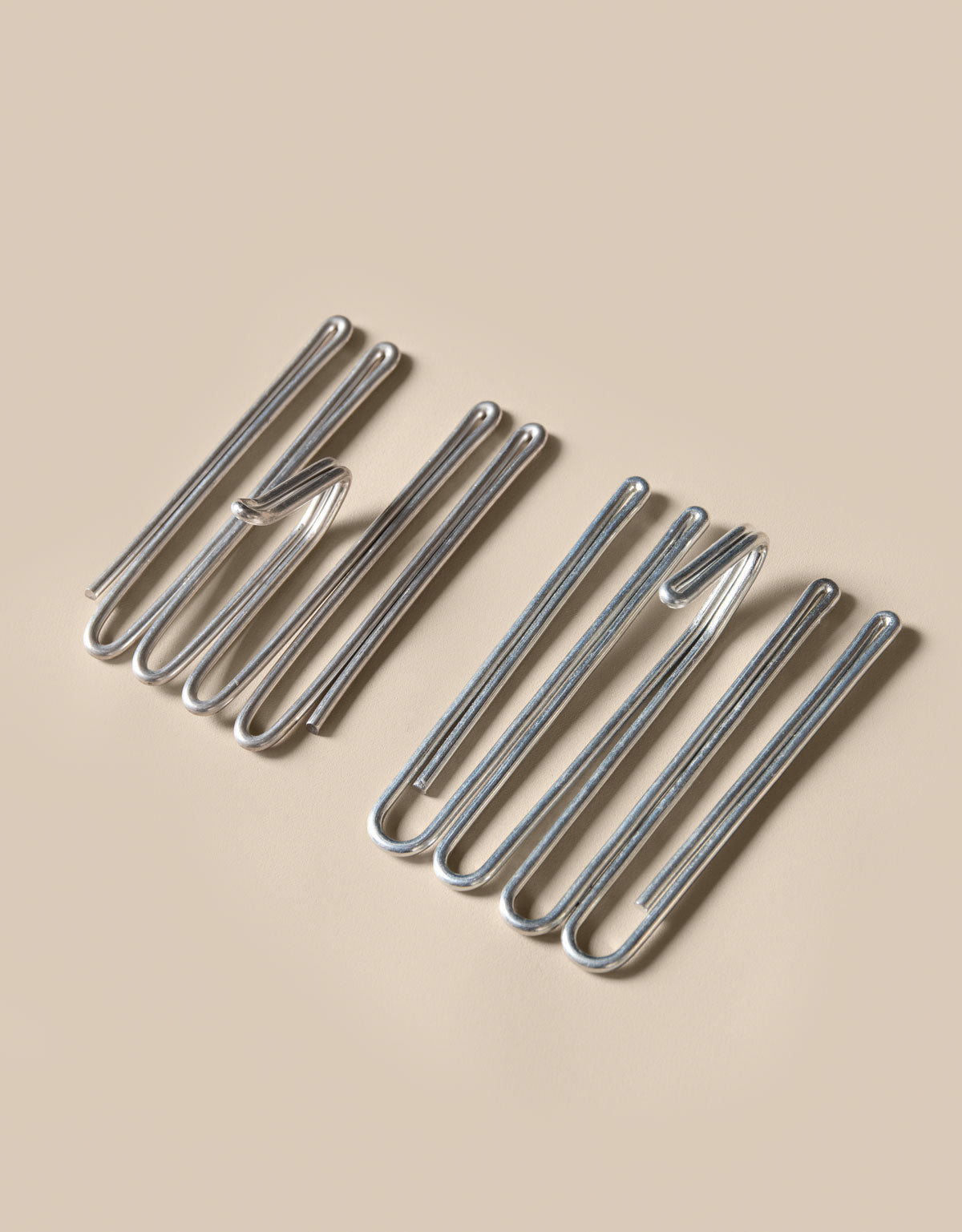
Pleat hooks are available in several variations: 1-, 2- or 4-pleat hooks, and with low or high settings. The number of pleats affects the type of fold you get:
- 1-pleat hook: creates soft waves, similar to a gathering tape hook.
- 2-pleat hook: creates smaller, simple pleats.
- 4-pleat hook: creates French pleats (reversed pleats) and more pleats per hook.
Spacing between pleat hooks
A common starting point is to place pleat hooks approximately 5 cm apart (i.e., between the individual hooks). If you place the hooks closer together, you will get more pleats, but the curtain will also be narrower when hung.
Spacing between the fingers on the same hook
For 2- and 4-pleat hooks, the number of pockets you use between the fingers also affects how pronounced the pleats become.
For a 4-pleat hook, for example, you can use approximately 7 pockets between finger 2 and 3 to achieve clear reversed pleats.
High and low grip
The difference between a low and high attachment is where the curtain ends up in relation to the track.
Low attachment (glider hook)
A low pleater hook, also called a glider hook, means the curtain sits higher up and can help to conceal the track. It can be used with many of our curtain tracks, but does not work with all models, as some tracks have a low profile where the curtain might hit the ceiling. To see exactly which tracks the glider hook is compatible with, please refer to our overview of all curtain tracks.
High attachment (loop hook)
A high pleater hook, also called a loop hook, means the curtain hangs below the track. It can be used with all tracks in our range and is also suitable if you want to hang the curtain with curtain rings on a rod.
Choose a low attachment if you want the curtain to sit high and conceal the track, and a high attachment if you want the curtain to hang below the track or with rings on a rod.
4-prong hooks

1. Turn the hook towards the curtain and place finger 2 in a pleat.

2. Rotate the curtain hook to the side so you can access finger 3 and the hook locks into the combo tape. The hook part should then face away from the curtain and towards you.

3. Place finger 3 in a pleat, with approximately 7 pleats between finger 2 and 3, to create a distinct crease.

5. Repeat along the entire curtain, spacing the hooks evenly (approximately 5 cm) for a uniform result.
2-finger hooks

1. Place finger 1 in a loop with the hook facing you.

2. Thread finger 3 into the next loop. The more loops you leave between fingers, the deeper the pleat will be.

3. Repeat along the entire curtain, spacing the hooks evenly (approximately 5 cm apart) for a uniform result.

4. Check the result: the curtain should have even, regular pleats along its entire width.
Instructional videos for more curtain hanging methods
This guide reviews the most common ways to hang curtains with combi tape. For more hanging options and visual demonstrations of how different curtain hooks are used, you can watch our instructional videos.
Common questions about curtain arrangements
How far apart should pleater hooks be placed?
A common recommendation is to place gathering tape hooks approximately 10 cm apart when hanging with gliders, and approximately 16 cm apart when using gliders on a cord. Closer spacing creates tighter waves, while wider spacing creates larger waves.
How many curtain hooks does one need per curtain?
The number of curtain hooks depends on the width of the curtain and how dense you want the pleats or waves to be. As a guideline, you can estimate about 10 hooks for a single-width curtain (132 cm) and about 20 hooks for a double-width curtain (268 cm), depending on how closely you space the hooks. It's recommended to use an even number of hooks to achieve even finishes on both sides of the curtain.
How much does the curtain gather when hung in pleats or waves?
How much the curtain gathers depends on the type of curtain hooks you use and how deep the pleats or waves you form are. For example, wave suspension (hotel waves) often takes up more width than pleats with finger hooks, as the waves are deeper than a regular pleat. As a starting point, you can expect the curtain's width to be roughly halved when hanging in pleats or waves.
Should the curtain be hung on a track or a rod?
You can create the same types of pleats and waves in the curtain with the right curtain hooks, regardless of whether you choose a curtain track or a curtain rod. On a curtain track, the hooks are hung in gliders that run in the track, and the hanging is often perceived as more functional and flexible. On a curtain rod, the curtain is usually hung on curtain rings, either with hooks in the rings or directly on the rod in the loops of the combi tape. The combi tape allows you to use several different hanging options on both tracks and rods, depending on the setup.
For more about hanging on a track, you can read our guide to curtain tracks.
If I want waves - should I choose a track or a rod?
Wave-fold curtains can be hung using both a curtain track and a curtain rod, where pleating hooks are attached to the gliders in the track or to curtain rings on the rod. However, this type of hanging is most common with a curtain track, especially with gliders on a cord, as it often creates more even waves that maintain their shape better when you pull the curtain.
Which curtain hooks can be used with comboband?
Combi tape can be used with many types of curtain hooks, such as pleater hooks and pinch pleat hooks (1-, 2-, and 4-finger, as well as high or low fitting). Which hook is suitable depends on the type of drape you want to achieve and whether the curtain will hang on a track or a rod. If the curtain lacks a heading tape, or if you have a rod pocket curtain without a heading tape, you can in some cases use needle hooks. The needle hook is inserted into the fabric, allowing the curtain to be hung on a track or on a rod with rings.
Hur hänger man upp gardiner med fingerkrokar?
Trä in fingerkrokarna i gardinens veckband eller comboband med jämna mellanrum. Välj mellan 1-, 2- eller 4-fingerkrokar beroende på vilken typ av veck du vill skapa. Häng sedan krokarna i gardinskenans glid eller i gardinringar på en stång och justera vecken för ett jämnt och fint resultat.
Vad är multiband?
Multiband är ett gardinband som sitter i gardinens överkant och gör det möjligt att skapa olika typer av upphängningar med samma band. Hastas variant kallas comboband och kan användas med olika gardinkrokar för att skapa veck, rynkor eller vågor. Bandet har även hällor så att gardinen kan hängas direkt på en gardinstång utan krokar.