
MEASURING GUIDE
How to measure roller blinds

Measure the width
How you should measure your window depends on how you plan to mount the roller blind. See below.
All our roller blind widths are given as overall measurements, which means the measurement of the roller blind including brackets. This means that the fabric is not as wide as the overall width. You can read about the exact measurements for each roller blind.
Wall or ceiling mounting
Wall or ceiling mounting is recommended when you want the fabric to cover the window, for example for blackout purposes, and you want to ensure there is no gap for light to shine through.
For blackout purposes, it is advisable to choose a measurement that is at least 5 cm wider than the window on each side, to minimize light leakage.
Niche mounting
When you want to install a roller blind that fits inside the window recess, it's important to measure carefully so that the roller blind actually fits between the walls of the recess.
Measure the recess in at least three places (at the top, in the middle, and at the bottom). Deduct 5 mm from the smallest measurement. This is the measurement you should order.
Note: This deduction does not apply to Tension blinds!
Tension - screwless roller blind for recess
When ordering Hasta Tension, you should always state the exact width of the window recess, and we will make the roller blind to fit that measurement perfectly. Always measure the recess exactly where the roller blind will be installed, in case the window is slightly crooked.
If you have a very crooked and uneven window, it is a good idea to check that there isn't more than a 1 cm difference in width on each side of the window recess. Otherwise, there is a risk that the roller blind will hit the sides when you roll it down.
Window-mounted roller blind Multifix and Fusion
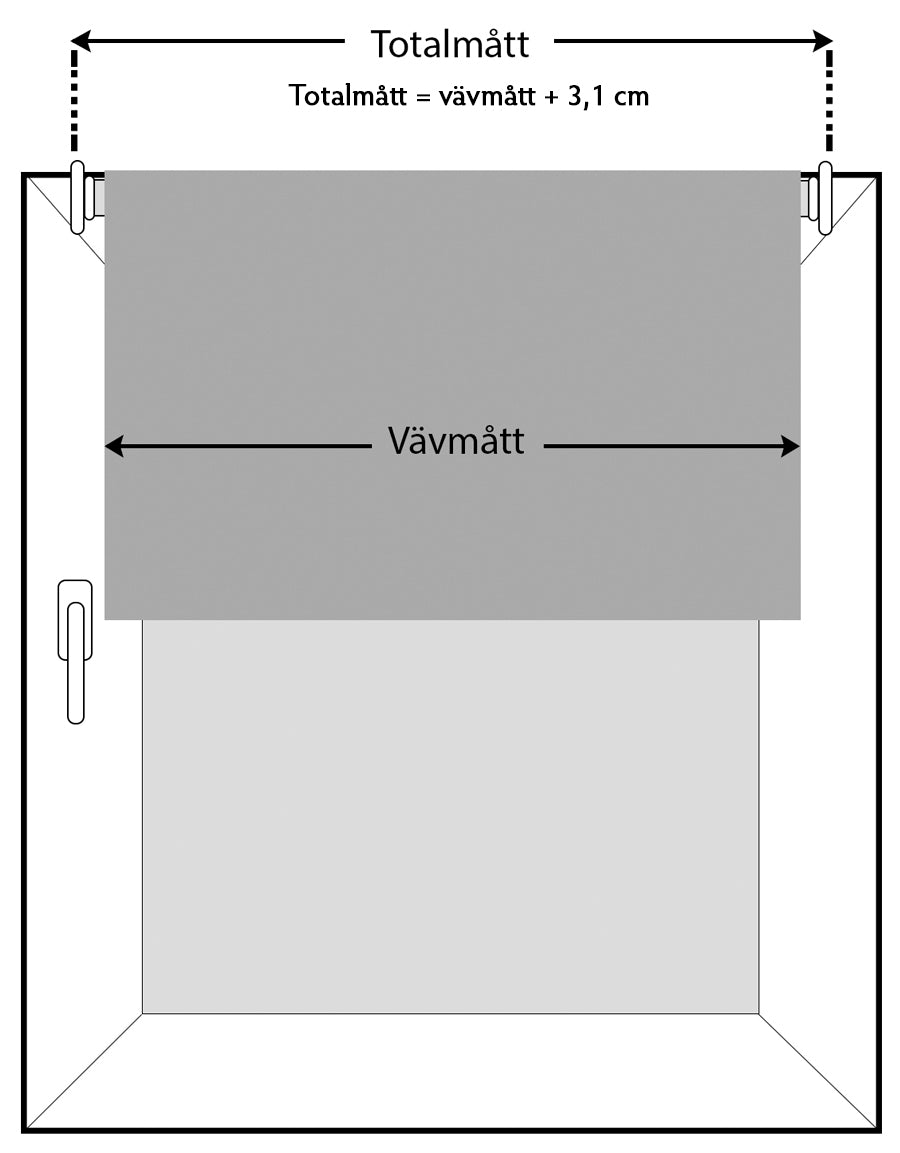
Multifix roller blind
Multifix is mounted directly on the window frame. For clamp brackets, the frame should be a maximum of 2 cm deep. If it is deeper and made of wood, you can use the included metal brackets which are nailed to the top edge, regardless of depth.
When measuring the width, the handle should be taken into account so that the fabric fits inside. The measurement you provide is the total width of the roller blind including brackets. The fabric width is approximately 3.1 cm less than the total measurement.
Measure height
Hastas roller blinds are available in fixed lengths and cannot be shortened in height. Several models have extra length for tall windows.
Functional height (referred to simply as height when ordering) indicates how far down the roller blind can be pulled. Measure the height of the window or the area you want to cover to choose the correct height. If the roller blind's height is greater than your window, simply do not pull the roller blind all the way down.
Important: Never pull the roller blind down past the indicated maximum height, even if there is fabric left. It needs an extra turn around the tube to be securely attached. If you pull too far, the fabric risks detaching.
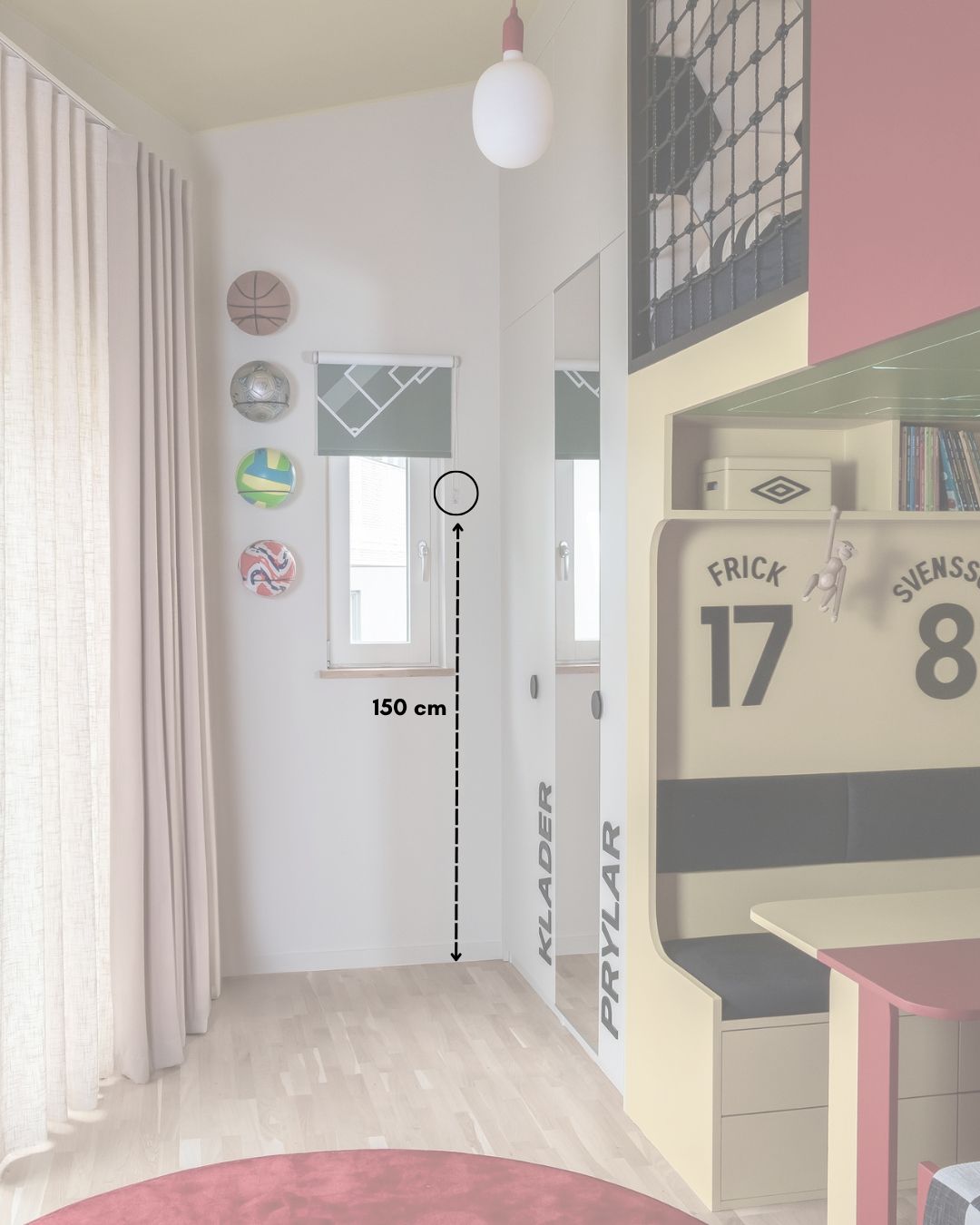
Mounting height - important for child safety
The mounting height determines the chain's position and length, ensuring it is out of reach of small children according to applicable safety regulations.
When measuring the mounting height, it's easiest to first mark where the sun protection will be installed. Then measure the distance from the floor to the top edge of the sun protection at its intended location – this measurement is the mounting height.
If you want to read more about requirements and safety regulations, you can read our guide on sun protection and child safety.
How we calculate the ball chain length:
Mounting height - 150 cm.
To hang at a child-safe distance, the ball chain should be 150 cm from the floor. This means that if your mounting height is, for example, 200 cm, the ball chain will be 50 cm long.
Always state the mounting height when ordering. If you choose "unknown," a standard chain of 100 cm will be delivered.
Do you want a specific chain length? Write it in the order notes. Available lengths: 30, 50, 60, 70, 90, 100, 125, 150, and 200 cm.
Common questions about measuring blinds
How much wider than the window should a roller blind be?
When darkening a room, it's important that the roller blind is wider than the window itself to minimize light leakage from the sides. A common recommendation is at least 5 cm extra on each side. For this to work, the roller blind needs to be mounted on the ceiling or on the wall outside the window. The wider the roller blind, the less light leakage from the sides.
How to measure for roller blinds?
How you measure for roller blinds depends on the model you choose and whether it will be mounted inside the window recess or outside the window. The measurements therefore differ depending on both the type of roller blind and its placement. See the respective measuring instructions higher up in the guide for the correct model and mounting.
How do I know what size of roller blinds to buy?
The size you need depends on where the roller blind will be installed and which model you choose. Start by deciding whether it should be inside the window recess or outside the window, and then follow the measuring instructions for the correct model and mounting method. All our roller blinds can be customized in width, and many models are also available in standard sizes.
Where should the roller blind be placed?
The placement of the roller blind depends on both the desired style and function. For blackout purposes, it is often best to mount the roller blind outside the window, preferably a bit above and wider, to minimize light leakage from above and from the sides. For shading fabrics and screen fabrics, it can instead be stylish to mount the roller blind inside the window recess, where it gives a more discreet impression.
Should I measure the entire roller blind or just the fabric?
You always specify the total width of the roller blind, including brackets, when ordering. It is also good to remember that the fabric itself is always a few centimeters narrower than the total measurement. The exact difference varies between different roller blind models.
What's the difference between recess mounting and external mounting?
The difference is about both appearance and function. For blackout, mounting outside the window is usually best, as you can then choose a wider measurement than the window itself and thus reduce light leakage from the sides. For roller blind fabrics that let in more light, many instead choose mounting in the recess, if possible, for a more discreet overall impression.
Glossary
Overall dimensions
The total width of the roller blind including wall brackets
Fabric dimensions
The total width of the fabric. It is approximately 3.5-4 cm less than the overall dimensions.
Functional height
The maximum height you can pull down the roller blind. The total height of the roller blind fabric is greater than the functional height. This is to ensure you never pull the roller blind all the way out, as there is a risk it could detach from the tube. Therefore, never pull the roller blind further down than the recommended functional height.
Mounting height
The height at which the roller blind is to be mounted. This height must be specified according to European law so that we can ensure that ball chains and cords are out of reach of small children.
Ball chain
The chain you pull to raise and lower the roller blind.
Bottom rail
The rod/rail that sits in the hem at the bottom of the roller blind and weighs it down so that the fabric hangs straight.
P-clips
A fastening device for the ball chain used to secure the ball chain to the wall so that it is out of reach of children.
Under-rolled
Means that the roller blind is rolled so that the roller is visible and the fabric comes close to the window. Recommended and standard for blackout blinds.
Over-rolled
Means that the roller blind is rolled so that the roller is not visible, which means the fabric comes a little away from the wall. Recommended for shading and decorative roller blinds and when you find it most aesthetically pleasing not to see the roller.